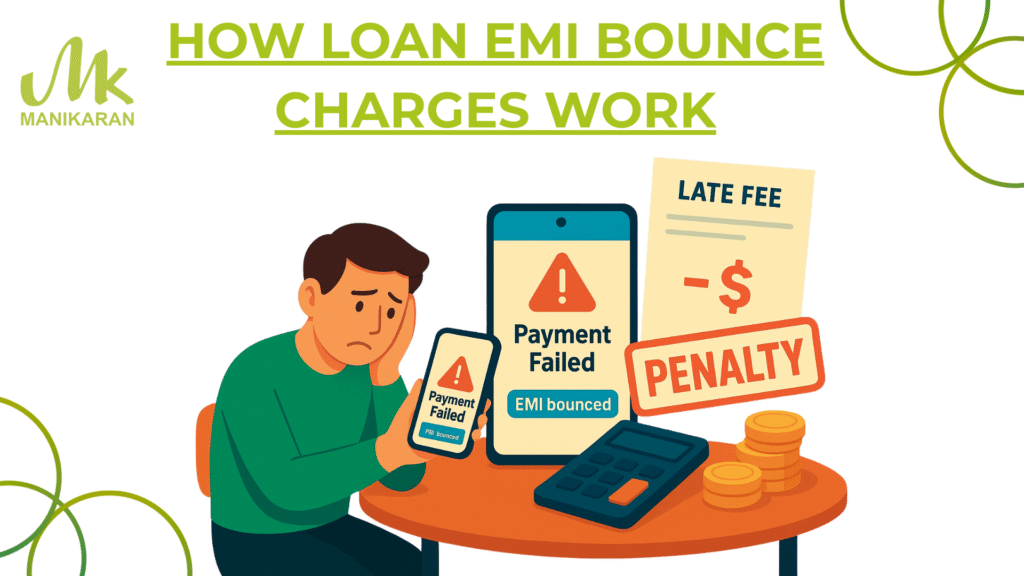
Loan EMIs were designed to make the repayment of loans easy, predictable, and stress-free. Whether it is a personal loan, business loan, home loan, or any other type of credit, a borrower relies on monthly EMIs to plan his finances smoothly. But should an EMI fail due to insufficient balance, technical errors, or delay in account funding, here comes the penalty imposed by lenders-known as loan EMI bounce charges. Though these charges may look small on the surface, several back-to-back EMI failures will place a heavy financial burden, lower your credit score, and make borrowing a difficult task in the future.
This detailed blog will explain how loan EMI bounce charges work, why lenders impose charges, what rules apply to penal interest, how a single EMI failure may affect your CIBIL score, and how borrowers can avoid getting these penalties over and over again. This is intended to be a comprehensive, SEO-friendly guide so readers will understand the financial consequences of EMI bouncing and learn ways to manage one’s loans responsibly.
Understanding EMI Bounce Charges in Simple Terms
An EMI bounce occurs if the lender tries to debit the monthly installment from the borrower’s bank account and the payment fails. This could be due to low balance, incorrect NACH activation, card failure, bank server issues, or delays in fund transfers. For every failure of the disbursal of EMI, the lender levies a bounce charge, sometimes in the range of ₹ 300 to ₹1,000 per attempt, depending on whether the lender is a bank or NBFC.
These charges are not the actual amount of EMI. Additional amounts that get added to the outstanding dues of the borrower are considered as penalties. In addition to bounce charges, the borrower may be levied bank return charges, late payment fees, and sometimes penal interest computed on the overdue amount. This cumulative cost makes a single missed EMI much more expensive than borrowers expect.
Why Lenders Charge EMI Bounce Penalties
EMI bounce charges are not meant to be just another source of revenue for lenders. There is an operational and regulatory rationale behind such penalties. When a payment bounces, the system of the lender needs to reprocess the transaction, trigger communication to the borrower, and mark the records internally. Banks, too, charge the lender their own failed transaction fee. To cover these internal expenses, the lender charges the borrower for each EMI bounce.
The EMI bounce charges also serve as a psychological reminder for borrowers to maintain adequate balance from a risk management point of view. A pattern of frequent EMI failures signals poor credit discipline. Lenders use these charges to discourage repeat delays and encourage borrowers to fund their accounts on time.
What happens when an EMI bounces
If an EMI bounces, three things happen virtually simultaneously. The lender marks the EMI as outstanding and carries it forward until the borrower pays up. The lender sends a system-generated message or email to the borrower stating the failure and charging the bounce charges. Depending upon the loan terms, late payment interest starts getting accrued on the due EMI until it is paid by the borrower.
In case of NBFC loans and some types of personal loans, the lender can try to re-debit the EMI after 24 to 48 hours. Each unsuccessful try can attract separate bounce charges if the loan agreement has provisions for multiple attempts. After several days of overdue, lenders start follow-ups through calls or reminders. If the period exceeds 30 days, the lender could report the delay to credit bureaus, and your credit score would be negatively affected.
Different Types of Charges Applied After an EMI Bounce
When borrowers think about EMI failure, they typically assume they will only pay the EMI amount and a small penalty. However, the total payable cost becomes much higher because several charges combine. The most common charges include bounce charges, late payment fees, bank return fees, and penal interest. Bounce charges are fixed amounts imposed for each failed debit. Late payment fees are additional penalties applied when the borrower pays after the due date. Bank return fees are charged by the borrower’s own bank for an insufficient balance. Penal interest is a percentage charge applied on the overdue amount, computed daily until repayment.
When all these charges add up, one missed EMI may set a person back by more than the EMI amount itself. Borrowers frequently fail to recognize the severity of EMI defaults, but the combined financial and credit score implications make it vital to understand how these charges apply and how rapidly they grow the total outstanding loan amount.
How EMI Bounce Charges Affect Your CIBIL Score
Most borrowers think that one EMI bounce would not affect their CIBIL score, particularly when they repay the amount shortly. However, lenders follow strict rules for reporting. Essentially, one EMI bounce does not reduce your score instantly, but if the overdue period crosses 30 days and it gets classified as a delayed payment, then this is reported to credit bureaus. Such a negative remark can reduce the borrower’s CIBIL score by 30 to 80 points depending on their credit history.
Once a delayed EMI is reported, it remains in the credit report for several years. It will reduce future loan approvals, credit card applications, or enhancements of limits. Lenders like customers with regular repayment history and no delays in EMI. In fact, repeated bounces of EMI become a strong leading indicator of financial stress and raise the credit risk profile of the borrower. Due to this, lenders will sanction loans at a high rate of interest or even disapprove future loan requests.
Regulatory Framework for Penal Charges and EMI Bounce Fees
The guidelines go on to say that the penal charges are a way to encourage good repayment behavior, not as a means to generate undue revenue. Consequently, the lenders have to ensure that penal charges are reasonable and not excessive and have to be transparent. Penal charges cannot be compounded, meaning that the charges levied should not grow over time due to interest applied on the penalty. RBI also asks lenders to disclose all loan EMI bounce charges, late payment fees, and other costs in the loan agreement before disbursement.
Borrowers should read the loan agreement carefully to understand how many times the lender can attempt automatic debit and how much they will charge for each failure. Many NBFCs attempt multiple debits in a single month, and the borrower may unknowingly incur repeated penalties. The understanding of the regulatory framework helps borrowers to identify whether they are being correctly charged or unfairly.
Why Repeated EMI Bounces Become a Serious Problem
Though the first EMI bounce is not considered alarming, repeated failures result in a long list of financial problems. The lender begins to perceive the borrower as a high-risk one. This may start a closer follow-up, more frequent reminders, and tight verification for loans in the future. If the amount overdue remains unrepaid for an unusually long time, lenders may categorize the account as a delinquent loan. Delinquency status not only brings damage to the borrower’s credit score but also leads to legal and recovery implications.
Once a number of such EMIs start bouncing, the amount due starts mounting at a fast pace owing to cumulative penalties and piling up interest. Even if the borrower intends to repay, the increasing burden may create financial pressure. This cycle can be prevented only when the borrower resolves the overdue amount promptly and ensures adequate balance before every debit date.
What Borrowers Should Do After an EMI Bounce
The immediate course of action after an EMI bounce would involve checking the available balance and funding the account immediately. The next step would be to pay the overdue EMI along with charges as soon as possible. Borrowers should also look at their loan agreement to confirm whether additional debits will be attempted. If the EMI date falls too early in the month, a borrower can request a due-date change. This helps align repayment with salary credit, hence reducing the risk of future EMI failures.
If the EMI bounce was due to a technical reason and not because of an insufficient balance, then borrowers need to intimate the lender with proofs. Banks do face downtimes at server ends during auto-debit timings. Lenders may reverse or adjust the charges in those cases, which again depends on their internal policies.
If the borrower is unable to manage monthly payments, then it is better to negotiate restructuring options with the lender rather than having EMIs continuously bounce. Restructuring can take place in the form of increasing the tenure of the loan or adjusting the EMI amount or even shifting modes of repayment. It is better to request financial support early instead of letting penalties accumulate. How to Completely Avoid EMI Bounce Charges The best way to avoid EMI bounce charges is by keeping enough balance in the bank account one day before the debit date. The borrower should keep track of the monthly EMI schedule and mark a reminder. If NACH is opted as auto-debit, then repayment will be seamless without any interference provided adequate balance is maintained. Borrowers with irregular cycles of income can maintain a buffer amount in the account to avoid last-minute shortfall. The EMI debtor can also ensure that no other major payments fall on the same date as the EMI debit date, including subscription debits, etc. Many borrowers rely on last-minute fund transfers, but delays in UPI settlements or bank processing lead to unintended EMI failures. It is safer to keep the required balance at least 24 hours in advance. Regularly checking bank SMS alerts and loan app notifications helps ensure timely action. Conclusion Loan EMI bounce charges are apparently simple penalties, but they mean much more than that. Every EMI failure triggers off a financial chain reaction in terms of penalties, bank return charges, interest, and probable damage to credit scores. Understanding the modus operandi of loan EMI bounce charges helps borrowers manage their finances more responsibly to avoid unnecessary penalties. Loan repayment discipline is among the key and strong pillars of good financial health. A borrower can ensure a safe credit score and have a hassle-free experience in borrowing if he pays the EMI on time, maintains enough balance in his bank account, and stays aware of lender rules.