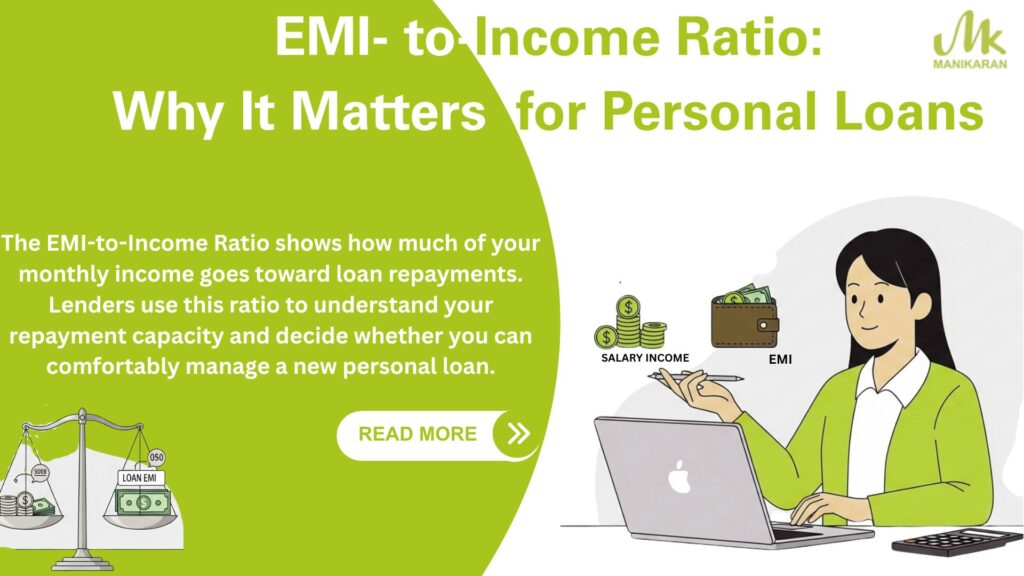
When you apply for a personal loan, lenders consider various financial parameters before sanctioning your loan. While most people are aware of the need to have a good CIBIL score and income eligibility, one of the most important parameters considered by lenders is the EMI-to-Income Ratio. It helps lenders understand how much of your income is already going towards repaying loans.
In short, the EMI-to-Income Ratio plays a crucial role in determining your eligibility for a personal loan, as well as the amount of loan sanctioned to you.
What is EMI to Income Ratio?
EMI to Income Ratio is a percentage of your income that is utilized to pay existing EMIs.
It is a tool that helps lenders assess your financial stability.
Simple Formula
EMI to Income Ratio Formula: (Total EMIs Paid / Income) x 100
Example:
Income: 50,000
Existing EMIs: 15,000
EMI to Income Ratio: (15,000 / 50,000) x 100 = 30%
This means 30% of your income is already being utilized to pay existing EMIs.
Why EMI to Income Ratio Matters for Personal Loans
For any lender, it is crucial to ensure that you are able to pay your loans without any financial pressures. The EMI to Income Ratio helps achieve this purpose.
1. Determines Your Loan Eligibility
If your EMI to Income Ratio is on the lower side, you are likely to be eligible to take up a new loan. On the contrary, if your EMI to Income Ratio is high, you are likely to be considered a high-risk borrower.
2. Impacts Loan Approval Chances
If your EMI to Income Ratio is balanced, you are likely to get your personal loan approved quickly. However, if your income is already being used to pay existing EMIs, your chances of approval are likely to be impacted negatively.
3. Affects Loan Amount
If your EMI to Income Ratio is on the lower side, you are likely to be eligible to take up a higher loan amount.
4. Shows Financial Stability
This ratio is likely to give a clear picture to your lender about your financial stability.
Ideal EMI-to-Income Ratio for Personal Loans
The majority of lenders look for a person whose EMI-to-Income Ratio is below 40-50%.
General Guidelines
EMI-to-Income Ratio What It Means
Below 30% Excellent
30% to 40% Safe zone for lenders
40% to 50% Relatively moderate risk
Above 50% High risk for lenders
If your EMI-to-Income Ratio is above 50%, lenders may not be willing to lend you a personal loan.
Factors That Affect EMI-to-Income Ratio
There are various financial factors that affect your EMI-to-Income Ratio.
Monthly Income
The monthly income that you earn is a major factor that will affect your EMI-to-Income Ratio. The more you earn, the more you are able to pay as EMI for other loans as well.
Existing Loan EMIs
Existing loan repayment obligations such as:
Home loan
Car loan
Personal loan
Credit card EMIs
will also affect your EMI-to-Income Ratio.
New Loan EMI
The EMI that you are willing to pay for your new loan is also a factor that will affect your EMI-to-Income Ratio.
How Lenders Use EMI-to-Income Ratio
Financial institutions make use of this ratio to assess:
Affordability
Repayment capacity
Financial stability
Risk level
Along with the CIBIL score, income proof, and stability of jobs, this EMI-to-Income Ratio is useful for financial institutions to make responsible lending decisions.
How to Improve Your EMI-to-Income Ratio
If your EMI-to-Income Ratio is on the higher side, there are various ways to bring it down before applying for a personal loan.
Reduction of Debts
Try to pay off debts that have smaller EMIs or credit card bills to bring down the total debt burden.
Boost Your Income
Having more income streams through bonuses, incentives, or side income will also bring the ratio into balance.
Avoid Too Many Loans
Applying for too many loans at the same time will put pressure on your financial situation and may not be approved.
Longer Repayment Period
A longer repayment period will automatically bring the monthly EMI amount down.
EMI-to-Income Ratio vs CIBIL Score
Though both are important, both have different uses.
CIBIL Score
It reflects your credit history and payment record.
EMI-to-Income Ratio
It reflects your financial ability to pay new loans.
It may happen that even if you have a high CIBIL score, the bank may reject your loan application if your EMI-to-Income Ratio is low.
Why Borrowers Should Pay Attention to This Ratio
While most borrowers pay attention to the loan amount and interest rates, they tend to ignore the importance of the EMI-to-Income Ratio. This might cause them financial stress in the future.
By maintaining an ideal ratio, you will be able to:
Manage your finances better
Avoid debt troubles
Improve your chances of loan approval
Maintain a healthy credit score
Final Thoughts
The EMI-to-Income Ratio is a vital determinant that decides your eligibility for a personal loan. The ratio assists the lender in assessing your capability to meet your loan obligations without affecting your financial stability.
By maintaining a healthy EMI-to-Income Ratio, you are more likely to get your loan approved or secure better loan deals while planning your finances better.
It is always advisable that before you apply for a personal loan, you should check your existing EMIs, income, and other financial obligations. A healthy EMI-to-Income Ratio is beneficial for your financial health as well.
SEO Keywords Included:
EMI to income ratio, personal loan eligibility, personal loan approval factors, EMI calculation, loan repayment capacity, personal loan requirements, debt to income ratio India.