

The “5 Cs” of Credit: How Lenders Judge Your Personal Loan Application
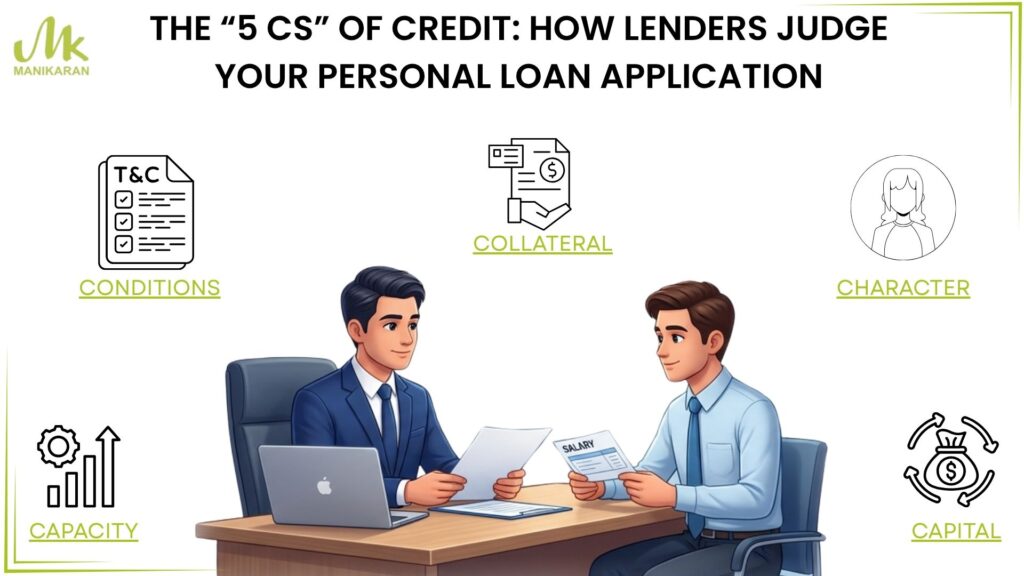
While taking a personal loan may now look easy, what happens in the background during each approval and rejection is not as easy as it looks. The 5 Cs of Credit is one such method used by financial institutions and banks to analyze the ability of a borrower to pay back their loan responsibly.
Character, Capacity, Capital, Collateral, and Conditions make up the 5Cs of Credit. All of these parameters allow the lenders to analyze your financial credibility and decide whether or not to approve your personal loan application.
Having knowledge about all of these parameters will go a long way in ensuring that your personal loan application gets approved easily and within minimal processing time. Whether you want to take a personal loan for medical reasons, weddings, studying, traveling, home improvement, or even consolidating loans, knowledge about these 5Cs will prove helpful.
Let’s discuss all these factors here.
Why Do Lenders Use the 5 Cs of Credit?
One problem is faced by all lenders – whether the borrower will pay back their loans in time or not. In order to minimize any risk to their money, lenders assess a borrower’s financial practices and capabilities to repay in advance.
The 5 Cs of Credit serve as a systematic approach to analyzing loan seekers. This system answers a series of questions that include:
Is the borrower financially responsible?
Is the salary of the applicant sufficient for repaying EMI?
Is there already too much debt on the borrower?
Is the loan amount justified under the prevailing market situation?
1. Character – Your Financial Reputation
Character stands for your financial integrity and willingness to repay back the borrowed money. Simply put, whether you’re honest or not while returning the money borrowed by you.
Your character is determined based on your:
Credit score
CIBIL report
History of loan repayment
Habits of credit card payments
Level of financial discipline
Having a high credit score depicts that you make timely payments and EMIs, making you reliable in the eyes of the lenders and hence increasing chances of getting personal loan approved quickly.
Whereas, any delay in EMI repayment, defaulting on loans, late payment or frequent settlement of the loan can harm your creditworthiness negatively.
Most lenders consider anything above 700 CIBIL score as a good score for getting personal loans approved. Some lenders might give loans with lower scores, but the rate of interest may be relatively higher.
Ways to Strengthen Your Character for Loan Approval
Punctual payment of EMIs and credit cards bills
Stay away from loan defaulting
Maintain a good credit utilization ratio
Do not apply for several loans simultaneously
Keep checking for errors in your credit report regularly
A clean credit history makes you look like a safe borrower, and this plays a crucial role in approving personal loans.
2. Capacity – Your Ability to Repay
Secondly, we have the element of Capacity, which means the capacity to repay. In essence, lenders thoroughly analyze whether you have adequate earnings to pay yet another EMI comfortably.
It is arguably the most crucial parameter for getting personal loans.
Here are some ways lenders assess capacity:
Monthly salary/business income
EMIs currently being paid
Debt-to-income ratio
Job stability
Work experience
In case of salaried people, stable employment and monthly income increase their chances of getting the loan. Self-employed people would require stable monthly incomes from their businesses.
Where too much of your income is going into EMI payments, your application becomes vulnerable due to risk perception on part of the lender.
Importance of Debt-to-Income Ratio
Most banks like to lend to applicants who do not exceed a certain debt-to-income ratio in terms of monthly EMI payment amounts.
For instance:
If you have a salary of ₹50,000, but your current EMIs are ₹30,000, you will have difficulty getting more loans.
This shows balance between expenses and income.
Improving Your Capacity
Reduce your outstanding debts before applying
Do not misuse credit cards for purchases
Stabilize your income
Apply for a reasonable loan amount
Apply for a manageable loan tenure
This aspect positively impacts your approval rate and loan terms.
3. Capital – Your Financial Reserves
The third “C” is Capital, referring to your savings, investments, and overall financial status.
Though personal loans are mostly unsecured loans, the lenders would still like borrowers to be financially safe.
Some forms of capital include:
Savings account balance
Fixed deposits
Investments
Mutual funds
Ownership of property
Emergency funds
Financial reserves assure lenders of your ability to handle any crisis without failing to make EMI payments.
If two people apply for loans with the same income and credit score, the applicant with higher financial reserves will probably get loan approval faster.
Importance of Capital
The lender assumes that financially sound borrowers are less prone to loan defaults due to emergencies such as job loss, health problems, or business slowdown.
This factor holds even greater significance for high-value personal loans.
How to Build a Strong Financial Portfolio
Maintain consistent savings
Create an emergency reserve fund
Don’t leave your bank account empty
Keep all financial records up to date
Though personal loans do not require collateral security, your financial stability is crucial for lenders’ reassurance.
4. Collateral – Guarantee for the Loan
The fourth “C” is Collateral, which refers to providing guarantee for the loan.
In conventional mortgage loans such as home and car loans, the lender will obtain the property or the vehicle as a guarantee. But for personal loans, it is unsecured, implying that you would not need to offer any asset.
Nevertheless, there are cases where collateral is necessary:
If the borrower has a low credit score.
If the amount borrowed is huge.
If the income is unstable.
Lenders might require:
Guarantor
Security through fixed deposits
Collateral through gold or other assets.
Offering collateral will minimize the risks taken by the lender and will enable the borrower to acquire the following benefits:
Low-interest rate
Higher loan amount
Easy processing
Unsecured Personal Loans Require Good Financial Profile
Easy processing
Unsecured Personal Loans Require Good Financial Profile