Manikaran Credit & Leasing Co. Pvt. Ltd

Non-Banking Financial Company (NBFC) registered with Reserve Bank of India
NBFC registered with RBI
Featured in
Media-Coverage

50/30/20 Rule for Loan Borrowers

50/30/20 Rule for Loan Borrowers

Applying for a personal loan can help solve a lot of financial problems and challenges such as medical emergencies, weddings, travels, etc. However, before applying for a loan, the most important question that the borrower should ask himself or herself is:
Will I be able to comfortably handle EMI without affecting my financial status?

This is where the infamous 50/30/20 rule for loan borrowers comes in handy.

The 50/30/20 rule is an easy yet very effective financial planning method by which individuals could effectively utilize their income, and at the same time, their loan EMIs do not burden them. In the year 2026, personal loans are easily accessible through NBFCs, so discipline is very much required.
In this comprehensive guide, you will learn:

What is the 50/30/20 rule

How does this apply to borrowers of personal loans?
How much EMI would be right for your salary?
Practical Examples for Salaried Individuals
Mistakes to Avoid
How NBFC borrowers can benefit from this rule

Let’s Begin.

What is the 50/30/20 Rule
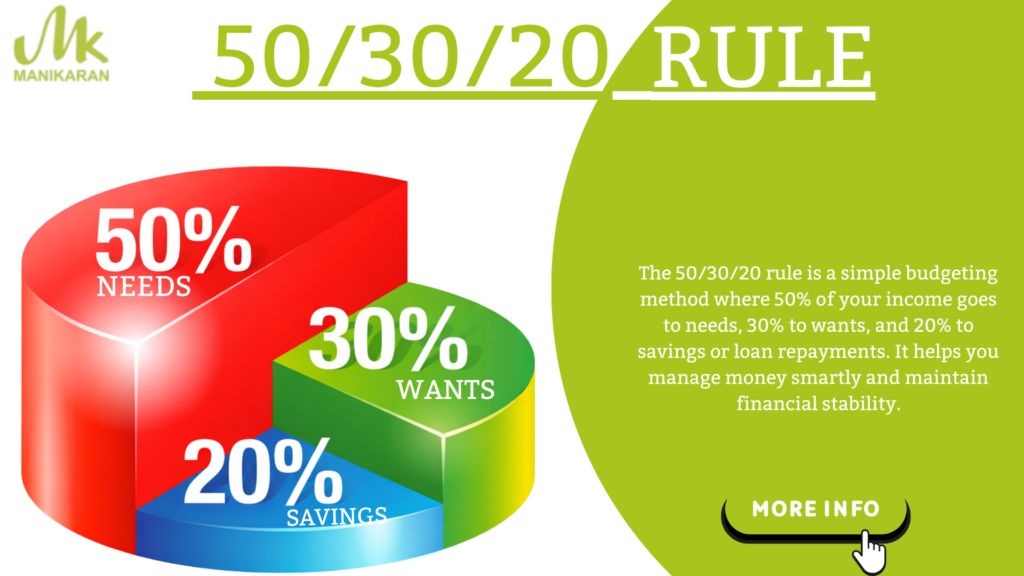
The “50/30/20” rule is a budgeting principle that suggests that your income should be split into the following categories:
50% for Needs
30% for Wants
20% for Savings & Investments
This principle ensures the maintenance of financial balance and control of overspending.
Although it started its journey as a personal finance tool, it has now been recommended that loan borrowers should make responsible EMI payments.
Understanding the 3 Categories

1️⃣ 50% – Needs 

This segment covers those unavoidable expenses we all have on a monthly basis, including:
House rent or home loan EMI
Groceries
Utility bills
Insurance Premiums
School fees
Transportation costs
Existing Loan EMIs
Personal loan EMI borrowers fall under this 50% bracket.
In a scenario where your basic living expenses are already exceeding 50%, taking up another personal loan could cause financial pressure.


2️⃣ 30% – Wants

This includes non-essential spending:
Dining out
Shopping
Entertainment subscriptions
Vacations
Gadgets
In case you are planning to take a personal loan, you might have to reduce this 30% section temporarily for your comfortable EMI.

3️⃣ 20% – Savings &

This is the most important part:
Emergency fund
SIP investments
Retirement planning
Fixed Deposits
Mutual Funds
Before taking up a personal loan, however, check whether you are not sacrificing the 20% completely.
If savings are reduced due to the EMI, financial risk will be high.

How the 50/30/20 Rule Helps Personal Loan Borrowers

Some borrowers only concentrate on loan eligibility instead of its affordability.
The banks and NBFCs determine their eligibility on:
Income
Credit score (CIBIL
Existing EMIs
But eligibility does not mean affordability.


The 50/30/20 rule

✔ You don’t overborrow
✔ Your EMI is manageable
✔ You avoid EMI bounce charges
✔ You have an acceptable CIBIL score ✔ You avoid loan stress
Practical Example: Salary ₹30,000
Let’s understand this with an example.
Monthly Salary: ₹30,
According to the 50/30/20 rule
50% Needs

30% Wants = ₹9,
Saving = ₹6,000
If your present essential expenditure is ₹12,000, you actually have an available space of ₹3,000 in the “Needs” category.
That means your safe EMI should ideally be within a limit of ₹3,000 to ₹4
Similarly, if you take a loan and set EMI of Rs.8,000, it will disturb your financial balance.

How Much Personal Loan EMI is Safe?

Financial experts suggest:
???? Total EMIs should not be more than 30-40% of the monthly income.
However, a more disciplined approach is provided by the 50/30/20 rule.
For safer borrowing:
No existing loans → EMI is manageable if income is up to 30%.
If you already have EMI’s → Keep total obligations within 50% of income.

Why This Rule is Important in 2026

With the rise of:
Instant personal loans
Digital lending apps
Quick NBFC approvals
One-click disburse
Borrowing is now extremely easy.
But easy borrowing can lead to:
Multiple loans
EMI overlap
Debt Trap
Poor CIBIL Score
The 50/30/20 budgeting rule helps to avoid such problems.

Benefits of Following the 50/30/20 Rule Before Applying for Personal Loans

1️⃣You only borrow what you can afford.
2️⃣ Improves Loan Approval
Lenders like to deal with those who have stable financial management.
3️⃣ Reduces EMI
Lower chance of penalty charges.
4️⃣ Protects Your C
Paying bills on time is also important
5️⃣ Maintains
Emergency funds are not drawn from loan EMI receipts.

Common Mistakes Loan Borrowers Often Make

❌ Taking a loan based on maximum eligibility
❌ Ignoring monthly cash flow
❌ Not maintaining Emergency Fund ????
❌ Reliance on credit cards for EMI services
❌ Во-первых, имеем несколько личных Remember: It does not matter whether NBFC sanctions an amount of ₹5 lakhs or not, you should not take an amount of ₹

When Should You Adjust the 50/30/20 Rule?

The rule is flexible.
You may temporarily adjust to:
60/20/20 (during high E
50/20/30 (if savings are
However, avoid long-term imbalance.
50/30/20 Rule for Different Salary Levels
**Salary**
Safe EMI range: ₹3,000 – ₹5
Salary ₹40,
EMI Range: ₹8,000 – ₹12,
Salary 60,
Safe EMI Range: ₹15,000 – ₹20
Always calculate before applying.
Benefits for NBFC Borrowers Who Can Avail This Rule
Reasons why NBFC personal loans are popular:
Faster approval
Flexible Documentation
Available for low CIBIL customers
But interest rates may be slightly higher than those of the banks.
Using 50/30/20 rule
EMI stays within limit
Interest burden is manageable
Loan tenure selected carefully
Step-by-Step: Apply 50/30
Calculate monthly net income
List All Essential Expenses
Subtract from 50% bracket

Check how much EMI space is available Compare Loan EMI Options Comfortable Tenure Options Never choose the shortest tenure if EMI becomes stressful.

Is 50/30/20 Rule Perfect for Everyone?
There is no budgeting principle that everyone follows.
It may not fit perfectly for:
High income earners
Joint family earners
Business Owners
And it works extremely well for salaried personal loan borrowers.

Final Thoughts

Nothing is wrong with taking a personal loan.
However, taking a loan without financial planning is risky.
The “50/30/20 rule” for those seeking loans is a simple yet effective tool that can:
Maintain financial discipline
Avoid debt trap
Manage EMIs well
Protect credit score
Ensure long-term financial stability
Before applying for a personal loan in 2026, it’s worthwhile to consider the following:
“Does this EMI fit inside my 50% needs category?”
If yes, then you are borrowing smartly.
If no, re-evaluate the quantity or term.

Financial discipline today avoids financial stress tomorrow.

Primary Keywords:
50/30/20 rule for loan borrowers
50/30/20
safe EMI for salary
how much personal loan EMI is safe
personal loan budgeting tips
personal loan eligibility calculation
EMI planning before taking loan
ideal EMI percentage of salary
financial planning before personal loan
how to manage personal loan EMI
personal loan affordability calculator
debt to income ratio
India

EMI Management Tips

how much loan can I take for a salary of ₹30,000 best budgeting rule before taking personal loan 50/30/20 rule example from India salary based loan planning guide 2026 Safe Borrowing Policy for NBFC Loan

Leave a Comment

Your email address will not be published. Required fields are marked *
